Fakhredin Blog
The posts in this weblog are mainly about history, heritage, language, art, and culture of Persia (that is named Iran since 1934). Persia is, therefore, equal to Iran, and Persian is equal to Iranian. Note that Persian is a nationality not an ethnicity. Pars (or Fars) is the major ethnicity in Persia but there are also Persian Kurds or Arabs. Similarly, the official language in Persia is Persian (Farsi is the local name and may not be used internationally). For more details please read my posts.
Thursday, August 23, 2007
Google Earth 4.2: Google Sky!
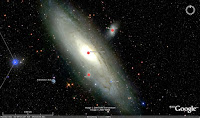 You know about Google Earth, don't you? It is an wonderful work from Google by which you can observe satellite images from every corner of the earth. Yesterday a new version of Google Earth is released; version 4.2. Amazing thing about this version is that you can observe not only the "Earth" but also the "Sky!" With this new option you sit behind your computer and look at the hundred millions of stars. I installed the program on my MacBookPro just a few minutes ago, and took this photo of Andromeda Galaxy (Messier 31, NGC 224). I also took a look at the planets, but suddenly the computer hanged! This is very unusual for a Mac computer. Anyhow, happily it works fine now.
¶ 1:15:00 pm
0 Comments
You know about Google Earth, don't you? It is an wonderful work from Google by which you can observe satellite images from every corner of the earth. Yesterday a new version of Google Earth is released; version 4.2. Amazing thing about this version is that you can observe not only the "Earth" but also the "Sky!" With this new option you sit behind your computer and look at the hundred millions of stars. I installed the program on my MacBookPro just a few minutes ago, and took this photo of Andromeda Galaxy (Messier 31, NGC 224). I also took a look at the planets, but suddenly the computer hanged! This is very unusual for a Mac computer. Anyhow, happily it works fine now.
¶ 1:15:00 pm
0 Comments


* Also available in Persian language
 You know about Google Earth, don't you? It is an wonderful work from Google by which you can observe satellite images from every corner of the earth. Yesterday a new version of Google Earth is released; version 4.2. Amazing thing about this version is that you can observe not only the "Earth" but also the "Sky!" With this new option you sit behind your computer and look at the hundred millions of stars. I installed the program on my MacBookPro just a few minutes ago, and took this photo of Andromeda Galaxy (Messier 31, NGC 224). I also took a look at the planets, but suddenly the computer hanged! This is very unusual for a Mac computer. Anyhow, happily it works fine now.
¶ 1:15:00 pm
0 Comments
You know about Google Earth, don't you? It is an wonderful work from Google by which you can observe satellite images from every corner of the earth. Yesterday a new version of Google Earth is released; version 4.2. Amazing thing about this version is that you can observe not only the "Earth" but also the "Sky!" With this new option you sit behind your computer and look at the hundred millions of stars. I installed the program on my MacBookPro just a few minutes ago, and took this photo of Andromeda Galaxy (Messier 31, NGC 224). I also took a look at the planets, but suddenly the computer hanged! This is very unusual for a Mac computer. Anyhow, happily it works fine now.
¶ 1:15:00 pm
0 Comments
Sunday, September 03, 2006
From "Mathematics in Persia" to "Geometric Patterns in Islamic Art"
 Have you ever heard of Al-Sijzi, the 10th century Persian mathematician? Or do you know that one of the world's analemmatic sundials is recently built in Rasht, Persia? I think you will like reading this post:
From 11 Sep 2006 through 15 Sep 2006, there is a workshop in Leiden University, the Netherlands, about Geometric Patterns in Islamic Art. Let me write a bit of background how this workshop came to existence. In spring 2006, the Seminar on History of Mathematics in Iran (Persia) was organized at the Department of Mathematics of the University of Leiden (Netherlands) by Dr. Jan P. Hogendijk (one of the coordinators of the current workshop). In that seminar, Jan Hogendijk also conducted a series of optional short classes on the Persian and Arabic alphabet and on Qur'an recitation.
On May 14, the eight ex-participants of the seminar made a trip to Persia, together with Prof. Dr. Remke Kruk (another coordinator of the current workshop) and Jan Hogendijk. They performed three workshops, together with Prof. Dr. Mohammad Bagheri (the third coordinator of the current workshop), during a conference on Mathematics and Art from May 16 - May 18, 2006, which took place in the House of Mathematics in Esfahan.
After the conference, some members left Esfahan and returned to the Netherlands. The remaining members of the group stayed for another week in Persia, and travelled to Yazd, Shiraz, and the province of Sistan and Baluchistan in South-Eastern Persia. In the cities of Zahedan and Zabol, a small international conference on ancient and medieval astronomy was organized by the astronomical society Mehbang. During that conference, an astrolabe workshop was conducted, and Jan Hogendijk held a lecture on the 10th-century mathematician al-Sijzi, who came from that province.
 By the way, Mohammad Bagheri is the one who designed the analemmatic sundial in Rasht (also look at this link about the sundial in Rasht). You may also like to know that Jan Hogendijk and Mohammad Bagheri translated an interesting book from al-Sijzi:
Al-Sijzi, Ahmad ibn Muhammad, Treatise on Geometrical Problem Solving, ed. Bagheri, M., Hogendijk, J. Tehran: Fatemi Publications, 1996. Arabic text with Persian and English translations of a treatise on problem solving strategies in geometry, which resembles G. Polya's How to Solve It.
The workshop "Geometric Patterns in Islamic Art" is mentioned in an interesting article, "A heptagon from Esfahan," about mathematics and architecture in Persia. The article is published yesterday, 2 September, in a famous Dutch newspaper, NRC Handelsblad.
* Also available in Persian language
 Have you ever heard of Al-Sijzi, the 10th century Persian mathematician? Or do you know that one of the world's analemmatic sundials is recently built in Rasht, Persia? I think you will like reading this post:
From 11 Sep 2006 through 15 Sep 2006, there is a workshop in Leiden University, the Netherlands, about Geometric Patterns in Islamic Art. Let me write a bit of background how this workshop came to existence. In spring 2006, the Seminar on History of Mathematics in Iran (Persia) was organized at the Department of Mathematics of the University of Leiden (Netherlands) by Dr. Jan P. Hogendijk (one of the coordinators of the current workshop). In that seminar, Jan Hogendijk also conducted a series of optional short classes on the Persian and Arabic alphabet and on Qur'an recitation.
On May 14, the eight ex-participants of the seminar made a trip to Persia, together with Prof. Dr. Remke Kruk (another coordinator of the current workshop) and Jan Hogendijk. They performed three workshops, together with Prof. Dr. Mohammad Bagheri (the third coordinator of the current workshop), during a conference on Mathematics and Art from May 16 - May 18, 2006, which took place in the House of Mathematics in Esfahan.
After the conference, some members left Esfahan and returned to the Netherlands. The remaining members of the group stayed for another week in Persia, and travelled to Yazd, Shiraz, and the province of Sistan and Baluchistan in South-Eastern Persia. In the cities of Zahedan and Zabol, a small international conference on ancient and medieval astronomy was organized by the astronomical society Mehbang. During that conference, an astrolabe workshop was conducted, and Jan Hogendijk held a lecture on the 10th-century mathematician al-Sijzi, who came from that province.
 By the way, Mohammad Bagheri is the one who designed the analemmatic sundial in Rasht (also look at this link about the sundial in Rasht). You may also like to know that Jan Hogendijk and Mohammad Bagheri translated an interesting book from al-Sijzi:
Al-Sijzi, Ahmad ibn Muhammad, Treatise on Geometrical Problem Solving, ed. Bagheri, M., Hogendijk, J. Tehran: Fatemi Publications, 1996. Arabic text with Persian and English translations of a treatise on problem solving strategies in geometry, which resembles G. Polya's How to Solve It.
The workshop "Geometric Patterns in Islamic Art" is mentioned in an interesting article, "A heptagon from Esfahan," about mathematics and architecture in Persia. The article is published yesterday, 2 September, in a famous Dutch newspaper, NRC Handelsblad.
Labels: Art, Astronomy, Persian heritage
¶ 12:50:00 pm 0 Comments
Saturday, August 26, 2006
Anousheh Ansari, the first Persian astronaut
 ..... and the first Persian astronaut!
This is something to be proud of. Anousheh Ansari will be the first Persian astronaut, and the first female space tourist. On 14th of September this year, she will go for a 10 days trip to the space, together with two other astronauts from Russia and the US. Before her, two Americans and one South African person have done such a trip as space tourists.
Anousheh Ansari, who is a Persian Azeri (Turk), is born in Tehran and immigrated to the US when she was 16. She received her master's degree in electrical engineering and computer science at George Washington University. She is a co-founder of Telecom Technologies, Inc. (TTI), which she sold later. Anousheh was listed in Fortune magazine's "40 under 40" list in 2001 and honored by Working Woman magazine as the winner of the 2000 National Entrepreneurial Excellence award.
Two years ago, along with her brother-in-law Amir Ansari, she made a multi-million dollar contribution to the X-Prize foundation. The X-Prize was officially renamed the Ansari X Prize in honour of their donation.
 Read the detailed story from CBS News. If you like, have a look at the Anousheh Ansari's page in Wikipedia. There you can find some interesting links to her personal blog, and also to the news of her achievements that are published in various websites.
* Also available in Persian language
..... and the first Persian astronaut!This is something to be proud of. Anousheh Ansari will be the first Persian astronaut, and the first female space tourist. On 14th of September this year, she will go for a 10 days trip to the space, together with two other astronauts from Russia and the US. Before her, two Americans and one South African person have done such a trip as space tourists.
Anousheh Ansari, who is a Persian Azeri (Turk), is born in Tehran and immigrated to the US when she was 16. She received her master's degree in electrical engineering and computer science at George Washington University. She is a co-founder of Telecom Technologies, Inc. (TTI), which she sold later. Anousheh was listed in Fortune magazine's "40 under 40" list in 2001 and honored by Working Woman magazine as the winner of the 2000 National Entrepreneurial Excellence award.
Two years ago, along with her brother-in-law Amir Ansari, she made a multi-million dollar contribution to the X-Prize foundation. The X-Prize was officially renamed the Ansari X Prize in honour of their donation.
Read the detailed story from CBS News. If you like, have a look at the Anousheh Ansari's page in Wikipedia. There you can find some interesting links to her personal blog, and also to the news of her achievements that are published in various websites.Labels: Astronomy, Persian heritage
¶ 3:21:00 pm 2 Comments
Goodbye Pluto!
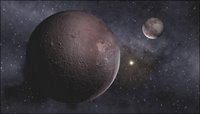 About 10 days ago, I wrote about the meeting of the International Astronomical Union (IAU) in Prague for deciding Pluto fate. I predicted that we will end up with a solar system with only eight planets, and Pluto will not be consider an official planet anymore.
Well, I read today that my prediction came true! Pluto is now a "dwarf planet." Apparently some people disagree with this decision, but to my point of view this is they way it should be. Our solar system has only eight planets, and there are two astroid belts. You can read detailed news from The New York Times, or from BBC.
* Also available in Persian language
 About 10 days ago, I wrote about the meeting of the International Astronomical Union (IAU) in Prague for deciding Pluto fate. I predicted that we will end up with a solar system with only eight planets, and Pluto will not be consider an official planet anymore.
Well, I read today that my prediction came true! Pluto is now a "dwarf planet." Apparently some people disagree with this decision, but to my point of view this is they way it should be. Our solar system has only eight planets, and there are two astroid belts. You can read detailed news from The New York Times, or from BBC.
Labels: Astronomy
¶ 1:07:00 pm 1 Comments
Tuesday, August 15, 2006
Deciding Pluto fate
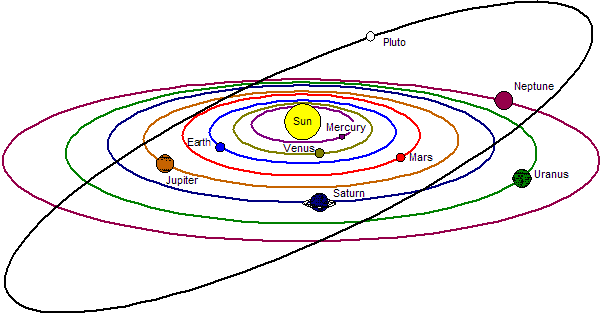 A few weeks ago there was a program in Discovery channel about the solar system and its planets. Pluto, which we knew it as a planet for more than 70 years, is not alone. Just like the astroid belt that exists between Mars and Jupiter, there is another astroid belt after Neptune, and Pluto is just one of those astroids! If Pluto was the largest astroids, the problem was not so serious. The point is that another astroid in that belt is discovered, which is larger than Pluto.
Now if we want to define a planet based on its size, we should consider the astroid larger than Pluto also a planet. Another option is to remove the name of Pluto from the list of planets of the solar system. Such a problem had also happened for the astroid belt between Mars and Jupiter. Astronomers had listed four planets in that region, which later were removed from the list and all included in the astroid belt.
Next week (21 August 2006), for 12 days, there is a conference in Prague, the capital city of Czech Republic. Astronomers are going to agree on definition of "planet," and decide on Pluto fate. I predict to have a solar system with only 8 planets and two astroid belts.
Read the detailed news in BBC.
* Also available in Persian language
A few weeks ago there was a program in Discovery channel about the solar system and its planets. Pluto, which we knew it as a planet for more than 70 years, is not alone. Just like the astroid belt that exists between Mars and Jupiter, there is another astroid belt after Neptune, and Pluto is just one of those astroids! If Pluto was the largest astroids, the problem was not so serious. The point is that another astroid in that belt is discovered, which is larger than Pluto.Now if we want to define a planet based on its size, we should consider the astroid larger than Pluto also a planet. Another option is to remove the name of Pluto from the list of planets of the solar system. Such a problem had also happened for the astroid belt between Mars and Jupiter. Astronomers had listed four planets in that region, which later were removed from the list and all included in the astroid belt.
Next week (21 August 2006), for 12 days, there is a conference in Prague, the capital city of Czech Republic. Astronomers are going to agree on definition of "planet," and decide on Pluto fate. I predict to have a solar system with only 8 planets and two astroid belts.
Read the detailed news in BBC.
Labels: Astronomy
¶ 10:54:00 pm 1 Comments